

Emailsupport@efile720.com
Support (628) 267-4400
(Monday - Friday 5:00 am to 7:00 pm PST)
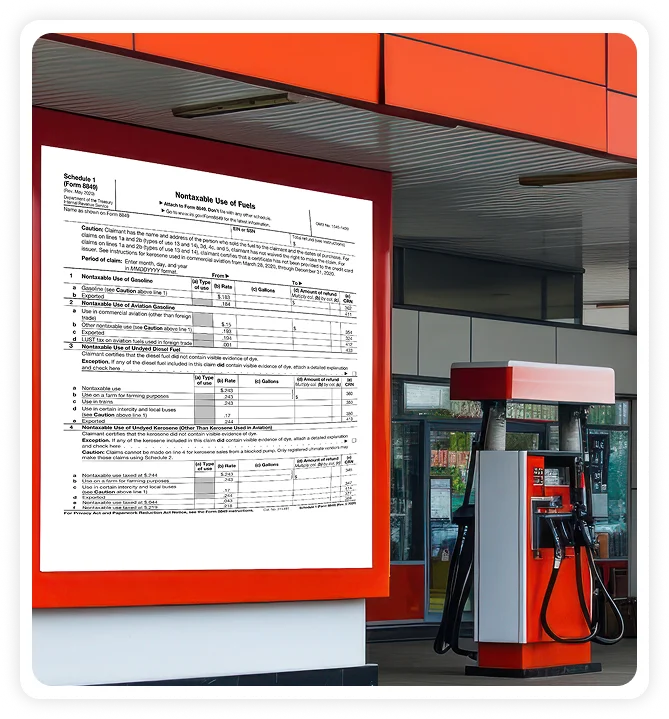
Ultimate vendors who are registered and have a valid IRS Form 637 registration (for example, an activity letter "UV" for gasoline/diesel fuels, "UA" for aviation, etc.) will use Schedule 2 when they sell fuel to buyers for nontaxable use.


Registration must specifically cover the claimed fuel type and activity.

To submit a valid refund claim using Schedule 2:

Per each fuel/use line:

Select IRS Table codes for use:
Keep buyer certifications for each fuel/activity; neglecting this may result in rejection of the claim.

When handling export lines, hold onto the following proof:
Maintain the records for 3 years (longer during an audit); submit to the IRS upon request.
Sales invoices, buyer certifications, Form 637 details, and use codes.
Complete Schedule 2 with gallons, tax, and claim amounts; total to Form 8849 (ensure you meet the $750 min.).
Mail paper documents to the IRS address or e-file through an authorized provider.
Quarterly post-sale quarter.
Retain 3+ years; monitor via provider (processing: 6-12 weeks).


By cross-checking the tax registration number (e.g., UV, UB, UP, UA) on Form 637 of your company against IRS requirements before submission, our platform ensures that only eligible vendors will go ahead with the claim.
This will prevent vendors from getting rejected due to an invalid status.
The system automatically names the exact IRS codes for the types of fuel (e.g., gasoline, diesel, kerosene) and the per-gallon rates from Schedule 2 instructions, the latest.
The errors in manually selecting the rates connected to the claim lines, like 1a-5b, are eliminated.
Validation incorporated in the system will raise a flag if there is a mismatch between the tax identification number, the quantity of gallons, waivers from the buyer, or if the calculations are inconsistent with the source documents.
Certified documents are a common trap, and also double-period filings, which are generally caught beforehand with this system, guaranteeing proper filings.
Submission to the IRS Modernized e-File (MeF) for Schedule 2 is done through a direct channel that has been approved, with encrypted data handling.
This way, the problem of paper filing will not be a matter of concern, and standalone claims are supported without having to be related to income tax returns.
Acceptance letters and processing updates (Schedule 2 e-filing usually takes 20 days) are available via a real-time system monitoring.
Users have access to a panel for notices, offsets, or refund schedules, which will help in preparing budgets and cash flow planning.


Gasoline

Aviation gasoline

Dyed & Undyed Diesel

Certain alternative fuels

K-1 Kerosene
| Quarter of Fuel Use | Filing Period | Due Date |
|---|---|---|
| Jan-Mar (Q1) | Apr 1 - Jun 30 | Jun 30 |
| Apr-Jun (Q2) | Jul 1 - Sep 30 | Sep 30 |
| Jul-Sep (Q3) | Oct 1 - Dec 31 | Dec 31 |
| Oct-Dec (Q4) | Jan 1 - Mar 31 | Mar 31 |

With the IRS now constantly emphasizing electronic filing, it is more important than ever to understand e-filing because it is becoming the standard.
Read More
If a company is in the business of providing tanning services to consumers, it must The collected tax must be reported and remitted to the IRS by filing IRS Form 720 on a quarterly basis.
Read More
Owning or operating a tanning salon comes with unique operational and financial responsibilities. One area where many business owners struggle is tax compliance.
Read More