

Emailsupport@efile720.com
Support (628) 267-4400
(Monday - Friday 5:00 am to 7:00 pm PST)
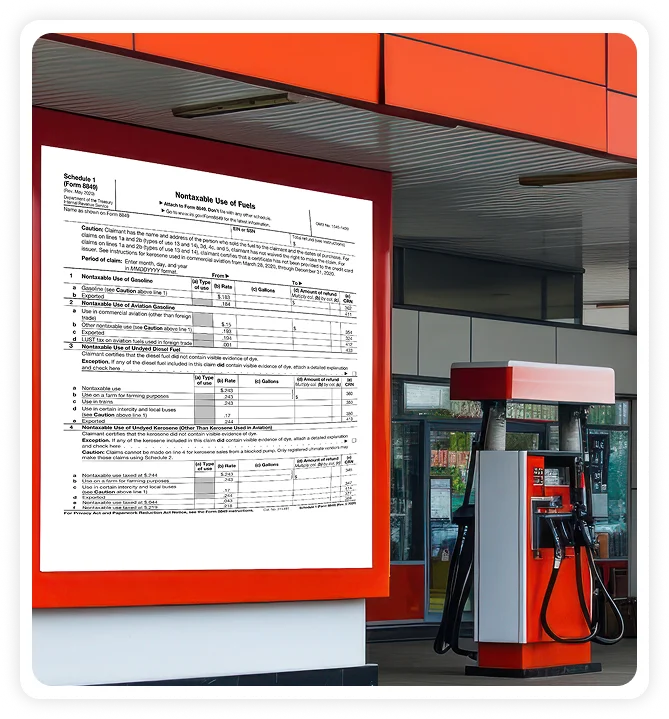
Schedule 3 must be filed by those taxpayers who are holders of the IRS Form 637 registration (for instance, "L" would be for those producing/selling biodiesel/renewable diesel/SAF mixtures, and "V" would be for alternative fuel sellers).
They are eligible if they are producing mixtures or selling and using alternative fuels in accordance with the IRS rules.


Fleet operators generally use Schedule 1 or Form 4136 when claiming tax-free uses.

Applicants who have a valid Form 637 registration by the IRS for the respective activity, are using the qualifying fuels, and have either paid or have a legal obligation to pay excise tax will be considered for the claim.
Claims must be supported with production, blending, sale, or usage documentations, and if total quarterly claims made by a claimant through different Form 8849 schedules reach $750 or more, they will be eligible for the refund/credit.

Report the gallons of biodiesel mixtures on line 2a, renewable diesel on 2b, SAF mixtures on 2c, and alternative fuels on lines 3-5a of Schedule 3. Multiply each of them by the per-gallon credit rate prescribed by the IRS, then add up all the line totals for the transfer to Form 8849.
Line 2a (Biodiesel mixtures):
Line 2b (Renewable diesel mixtures):
Line 2c (SAF mixtures):
Lines 3-5a (Alternative fuels):

Schedule 3 allows one to claim credits for biodiesel mixtures on line 2a, renewable diesel mixtures on 2b, SAF mixtures on 2c, and for alternative fuels which include CNG, LNG, LPG, and hydrogen on lines 3-5a.
The p-series fuels are only eligible if approved by the IRS, and the credit rates for the different types of fuels and years vary.
IRS-registered producers or blenders (Form 637 "L") creating biodiesel mixtures from taxed fuels.
Registered producers/blenders of renewable diesel mixtures meeting IRS specifications.
Claimants producing sustainable aviation fuel mixtures are eligible for targeted credits.
Registered sellers/users (Form 637 "V") of CNG, LNG, LPG, hydrogen, or other approved fuels for vehicles.

Maintain your Form 637 (Activity Letters L or V), production/blending logs, meter readings, and batch records.
Secure all invoices showing excise tax disclosures and proof of tax-paid fuel.
Complete Schedule 3, then transfer totals to Form 8849. Ensure your claim meets the $750 minimum threshold.
File quarterly via paper or e-file (MeF). Expect a 6-12 week processing window.
Warning: Inadequate records may lead to denied claims, audits, or penalties.

Instantly verifies Form 637 status and activity letters ("L" or "V") via API to eliminate rejections.
Automatically applies current IRS per-gallon rates for biodiesel and SAF, ensuring accuracy without manual updates.
Real-time validation detects mismatched fuel codes or gallon entries, providing IRS-aligned corrections to prevent audits.
Submit via IRS-approved MeF channels with bank-level encryption. Track acceptance, offsets, and refunds in real-time through a centralized dashboard.

| Quarter of Fuel Use | Filing Period | Due Date |
|---|---|---|
| Jan-Mar (Q1) | Apr 1 - Jun 30 | Jun 30 |
| Apr-Jun (Q2) | Jul 1 - Sep 30 | Sep 30 |
| Jul-Sep (Q3) | Oct 1 - Dec 31 | Dec 31 |
| Oct-Dec (Q4) | Jan 1 - Mar 31 | Mar 31 |
With the IRS now constantly emphasizing electronic filing, it is more important than ever to understand e-filing because it is becoming the standard.
Read More
If a company is in the business of providing tanning services to consumers, it must The collected tax must be reported and remitted to the IRS by filing IRS Form 720 on a quarterly basis.
Read More
Owning or operating a tanning salon comes with unique operational and financial responsibilities. One area where many business owners struggle is tax compliance.
Read More