

efile720.com
efile720.com
Support (628) 267-4400 (Monday - Friday 5:00 am to 7:00 pm PST)
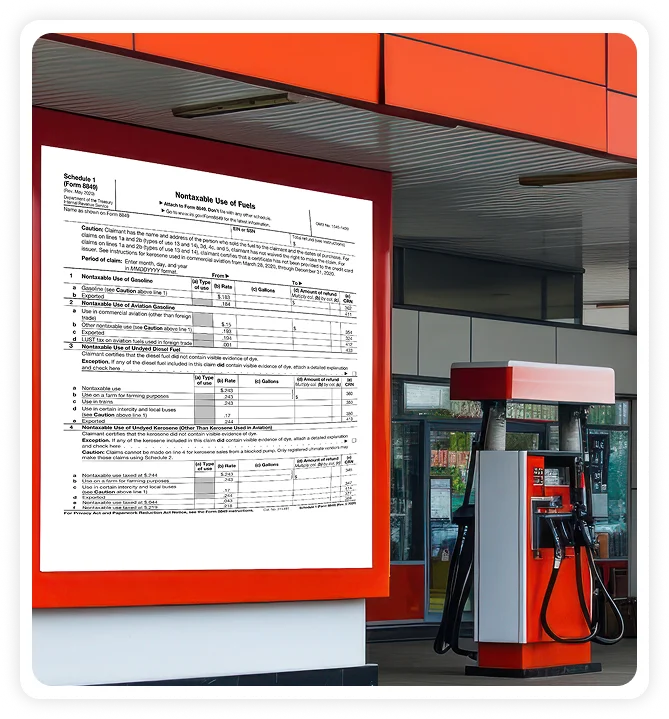
Schedule 8 Registered Credit Card Issuers - Form 8849

IRS Form 8849 Schedule 1
  • Schedule 8 allows IRS-registered credit card issuers to claim refunds for Section 4081 taxes paid on fuel sold to specific exempt buyers via credit card: state/local governments (all fuel types on Lines 1a-4) or qualified nonprofit educational organizations (gasoline on Line 1a; aviation gasoline on Line 3a). Nontaxable uses by ultimate vendors (e.g., off-highway business, farming) are claimed separately via Schedule 5 or Form 4136, not Schedule 8.

Who Must Submit Schedule 8

Schedule 8 is filed by IRS-registered credit card issuers (as per Form 637, Registration Type "CC") that had to pay Section 4081 tax on gasoline, diesel, kerosene, or aviation fuel that was sold to nontaxable users and paid through credit card transactions.

The following are eligible filers:

Registered issuers with a valid Form 637 CC registration.

Claimants who have cardholder statements or sales summaries to prove nontaxable uses.

IRS-registered entities that are making adjustments for overpayments on fuel related to exempt buyers (govts/nonprofits). The nontaxable uses by ultimate vendors will have to result in Schedule 5 or Form 4136.

Specific Instructions for Form 8849
Schedule 8

Claim
Requirements

The claimant should prove the tax paid on fuel sold for nontaxable purposes by providing evidence of a credit card payment, so the credit/refund claim can be considered legal.

  • Tax paid through quarterly Form 720.
  • Usage of fuel is limited to gasoline, undyed diesel, or kerosene (Section 4081).
  • Cardholder exemption statements and aggregate sales reports should be included.
  • Minimum $200 per Schedule 8 (combine lines or carry forward if under; no separate Form 8849 minimum).
  • Supporting documents: Copies of Form 720, transaction summaries, invoices, and buyer exemption certificates.

Refund
Calculation

Schedule 8 specifies the different fuel types and exempt uses for the claims. For each line, input:

  • The Section 4081 tax rate in Column (a)
  • Gallons sold for exempt uses in Column (b)
  • Tax paid (rate x gallons) in Column (f)

The totals from all lines should be transferred to Form 8849, Line 8.

Line Fuel Type Exempt Buyer Columns: Rate (a), Gallons (b), Tax Paid (f)
1a Gasoline Nonprofit educational org Enter Here
1b Gasoline State/local government Enter Here
2a Undyed diesel State/local government Enter Here
2b Undyed kerosene State/local government Enter Here
3a Aviation gasoline Nonprofit educational org Enter Here
3b Aviation gasoline State/local government Enter Here
4a Aviation-grade kerosene State/local government Enter Here
4b Other kerosene State/local government Enter Here

How to File Schedule 8

1. Required Documents

  • Registration Certificate of CC - Form 637
  • Form 720 - Quarterly returns, proof of payments.
  • Cardholder Statements: Sales reports or buyer's exemption certificates.
  • Details on Part II: The type of fuel, date of transaction, quantity, and tax paid.

2. Review the Data Thoroughly

  • "Identity" Test: Ensure consistency of the EIN and company name across all documents.
  • "Gallon" Test: Match transaction details with Form 720; inconsistencies imply the need for deeper examination.

3. Where to Start

  • Main Document: Review Form 8849.
  • Additional Form: Schedule 8 should be filled in with the registration number and the amount claimed.
  • Restriction: No more than one Schedule 8 per quarter; don't make claims in multiple parts.

4. How to Submit

  • E-file: Submit electronically via the IRS MeF system for faster processing.
  • Mail: On the envelope, write "Section 6416(a)(4)(C) Claim".
  • Processing Time: Usually 6-12 weeks.

Advantages of Our System

  • icon
    Automation Duplicate Recognition

    It performs a Form 720 record search for CC transactions and then auto-fills the reg. no., nontaxable dates, fuel type/gallons.

  • icon
    Correct Calculation

    It is guided by the current 4081 rates; it displays the total claim amount before submitting.

  • icon
    Document Integration

    It links statements/invoices with specific lines; it provides information about mismatches.

  • icon
    Error Reduction

    The system perfectly meets IRS CC regulations; quicker refunds to the submitting through the MeF are feasible.

  • icon
    Secure E-filing

    The dashboard tracks acceptance/refund status, days, not months.

Filing Deadlines

Quarter of Fuel Use Filing Period Due Date
Jan-Mar (Q1) Apr 1 - Jun 30 Jun 30
Apr-Jun (Q2) Jul 1 - Sep 30 Sep 30
Jul-Sep (Q3) Oct 1 - Dec 31 Dec 31
Oct-Dec (Q4) Jan 1 - Mar 31 Mar 31

Frequently Asked Questions

  • Registered CC issuers use it to obtain refunds/credits for Section 4081 taxes that were overpaid on nontaxable fuel sales to exempt buyers.
  • It is the legitimate way to recover tax on exempt sales to state/local governments or qualified nonprofits.

An IRS-registered CC (as evidenced by Form 637) issuer who can document that the fuel purchases using the card were subject to tax but for exempt uses by buyers like govts/nonprofits.

Quarterly; one Schedule 8 per quarter (min. $200 total per schedule; combine/carry forward if under).

  • Form 637 certificate of CC registration.
  • Form 720 returns reflecting tax payment.
  • The cardholder's exemption declarations or refuel summaries (fuel type, quantity, dates).
  • Supplier statements/invoices for your internal control.

Yes, the use of MeF for e-filing is suggested to speed up the handling and allow status tracking

Recent Blogs

Jan 06, 2026
The Ultimate Guide to Fuel Excise Tax E-Filing in the USA

With the IRS now constantly emphasizing electronic filing, it is more important than ever to understand e-filing because it is becoming the standard.

Read More

Jan 06, 2026
Online vs Paper Filing for the Tanning Excise Tax: Pros & Cons

If a company is in the business of providing tanning services to consumers, it must The collected tax must be reported and remitted to the IRS by filing IRS Form 720 on a quarterly basis.

Read More

Jan 06, 2026
5 Common Tanning Tax Filing Mistakes and How to Avoid Them

Owning or operating a tanning salon comes with unique operational and financial responsibilities. One area where many business owners struggle is tax compliance.

Read More
`